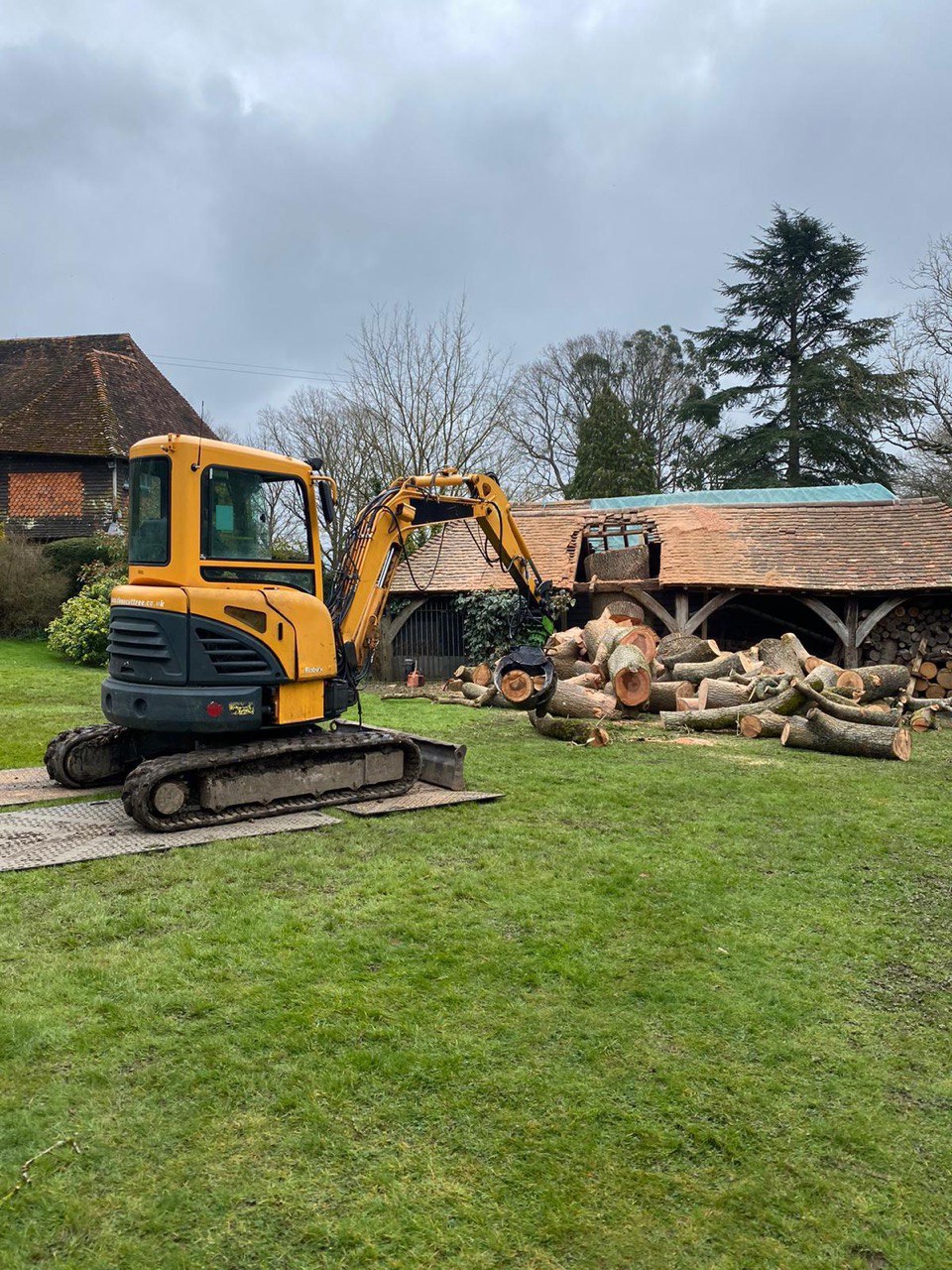
Trees can develop a wide range of problems as they mature. Dead branches, an uneven crown, storm damage or excessive growth can all make a tree appear concerning, but none of these signs automatically means that complete removal is necessary. In many situations, selective pruning, crown reduction, crown lifting or deadwood removal can address the problem while retaining the tree.
Tree felling becomes more relevant when deterioration or structural problems affect the tree more fundamentally, or when continued pruning is no longer providing a proportionate long-term solution. The challenge is distinguishing between an isolated defect and a pattern that affects the condition or suitability of the complete tree.
For homeowners in Sittingbourne, Kent, professional assessment can provide this distinction. By considering the crown, major branches, main stem, previous damage, species and likely future development, an experienced tree surgeon can determine whether appropriate tree surgery can retain the tree or whether felling deserves consideration.
What Signs Can Indicate That Tree Felling May Be Appropriate?
There is rarely one visual sign that confirms a tree needs removing. The significance of a defect depends on where it occurs, how extensive it is and what condition the remainder of the tree is in.
A tree with one dead branch presents a very different situation from one with widespread crown decline, repeated major branch failures and substantial structural damage.
The complete tree therefore needs to be considered rather than making a decision from one visible symptom.
Widespread Crown Dieback Deserves Investigation
Dieback occurs when parts of the crown begin to decline and branches stop producing healthy growth.
A small amount of localised dieback may be manageable through selective pruning.
Where the problem affects substantial sections of the canopy, however, it becomes more important to understand why.
Progressive dieback across several areas can indicate that the condition of the tree deserves broader assessment rather than simply removing individual branches as they decline.
Extensive Deadwood Can Indicate a Wider Problem
Dead branches occur naturally within many trees.
A small amount of deadwood does not automatically suggest that the complete tree is deteriorating. Appropriate deadwood removal may be all that is required.
The situation becomes more significant when deadwood is extensive and distributed throughout large areas of the crown.
When this is combined with reduced foliage, further branch decline or repeated failures, the overall condition of the tree should be investigated.
A Thinning Canopy Can Provide Useful Information
Different tree species naturally produce different levels of canopy density.
For this reason, a sparse-looking crown should not be judged without context.
A more useful observation is whether the canopy has changed significantly.
If a tree that previously produced healthy, consistent foliage begins becoming progressively thinner, particularly across several areas, professional assessment can help determine whether this reflects broader decline.
Repeated Major Branch Failure Should Not Be Treated as Isolated Damage
A tree can lose a branch without needing to be felled.
The remaining crown may continue to be suitable for retention after the damaged section has been removed correctly.
Repeated failure of substantial branches is more significant.
Each major branch loss changes the remaining structure. If failures continue, the tree can gradually become more difficult to manage through individual repairs alone.
Understanding the pattern is therefore more valuable than responding separately to each fallen branch.
Large Cracks in Structural Branches Need Careful Assessment
Cracks can develop within branches for several reasons.
Their importance depends heavily on their position and extent.
A damaged smaller branch may be suitable for selective removal, while a substantial crack affecting a major structural limb can require more detailed consideration.
The condition of the branch union and surrounding crown should also be examined.
One crack does not automatically require felling, but significant structural defects should not be judged solely from ground level.
Damaged Major Branch Unions Can Affect the Crown
The points where large branches join the tree play an important role in its structure.
Where major splitting or previous failures have affected these areas, the remaining branches may need closer assessment.
A localised defect can sometimes be addressed through targeted tree surgery.
If several important unions contain significant problems, however, the options for retaining an appropriate crown can become more limited.
Significant Main Stem Damage Can Be More Serious
Problems affecting the main stem are different from those involving individual outer branches.
Removing a damaged limb can sometimes eliminate a localised defect.
A substantial problem affecting the central stem cannot necessarily be addressed by pruning the crown.
The nature and extent of the damage therefore need to be understood before deciding whether continued management is appropriate.
A Major Structural Failure Can Change the Whole Tree
When a substantial part of a tree breaks away, the consequences can extend beyond the failed branch itself.
The remaining crown may become strongly unbalanced.
Branches that were previously sheltered can become more exposed, while future growth may develop differently because of the changed structure.
Some trees remain suitable for management following substantial branch loss.
Others can be left with such extensive structural changes that the long-term options need to be reconsidered.
Previous Storm Damage Can Reveal Existing Weaknesses
Strong weather can expose defects that were already present within a tree.
The most obvious result may be a broken branch, but other parts of the crown can also have been affected.
Following significant branch loss, assessing the remaining tree can help identify cracks, damaged unions or other changes that are not immediately obvious.
The objective is to understand the condition left behind rather than concentrating only on the material that has already fallen.
Repeated Damage During Strong Weather Is More Significant
An isolated branch failure during severe weather does not automatically indicate that a tree needs removing.
Repeated substantial failures deserve closer attention.
If different major limbs continue to fail, the pattern may indicate that the remaining structure needs professional assessment.
This can determine whether targeted tree surgery remains appropriate or whether the accumulated deterioration is becoming more significant.
Several Defects Occurring Together Can Change the Assessment
One of the most important principles in tree assessment is to consider how different signs relate to one another.
A small amount of deadwood may not be particularly significant.
An isolated damaged branch may also be manageable.
Extensive deadwood combined with progressive dieback, major cracking and repeated branch failure presents a substantially different picture.
It is often this combination of problems, rather than one individual defect, that makes tree felling more likely to be considered.
Continued Deterioration Over Time Matters
A tree should not always be judged from a single inspection of its appearance.
Changes over time can provide useful information.
Increasing deadwood, further crown thinning and repeated branch loss can demonstrate that deterioration is continuing rather than remaining stable.
Where a tree is progressively declining, its future management may need to be reconsidered.
Sudden Changes Can Be Worth Investigating
Homeowners often become familiar with the normal appearance of mature trees within their gardens.
A significant unexpected change can therefore provide useful information.
Sudden branch failure, rapidly developing crown thinning or a noticeable alteration in the tree’s structure can justify professional inspection.
These signs do not confirm that removal is required, but they provide good reasons to understand what has changed.
A Leaning Tree Does Not Automatically Need Removing
Trees do not always grow vertically.
Some develop angled stems naturally because of their growing conditions, surrounding vegetation or access to light.
An established lean is therefore not automatically a reason for felling.
A noticeable recent change in position is more relevant and should be considered alongside other observations.
Professional assessment can distinguish between a long-established growth form and a situation that deserves closer investigation.
An Uneven Crown Is Not Necessarily a Failing Crown
Trees rarely develop perfect symmetry.
Buildings, neighbouring vegetation, previous pruning and natural growth patterns can all influence crown shape.
An uneven tree may remain perfectly manageable.
The important consideration is why the crown has become unbalanced.
If asymmetry has resulted from major structural failures or substantial deterioration, the situation may require more attention than a tree that has simply developed naturally towards available space.
Previous Branch Loss Can Affect Future Development
The history of a tree can influence its current condition.
When large branches are removed or fail, remaining branches can become more dominant.
New growth may also develop around the changed crown structure.
Professional assessment considers how these previous events have influenced the tree rather than looking only at its current outline.
This can help determine whether continued pruning can maintain a suitable structure.
Previous Heavy Pruning Can Influence Current Problems
Past pruning can have a significant influence on future growth.
Where a tree has previously been reduced heavily, vigorous shoots may have developed around the pruning points.
The resulting crown can require different management from a tree that has developed naturally.
Understanding previous work is therefore useful when deciding whether further pruning remains appropriate.
Fungal Growth Should Be Considered in Context
Fungal growth can sometimes appear on or around trees.
Its significance varies considerably, and appearance alone is not enough to determine whether a tree should be felled.
Where fungal growth occurs alongside other signs of deterioration, professional assessment can consider it as part of the overall condition.
The important point is not to draw a major conclusion from one visible feature without examining the complete tree.
Size Alone Is Not a Reason for Tree Felling
A mature tree can become extremely large compared with the surrounding garden.
This can make it appear problematic even when it remains in reasonable condition.
Height or crown spread alone does not mean that removal is required.
Where excessive dimensions are the main concern, professional tree surgery can establish whether suitable crown management offers a more proportionate solution.
Crown Reduction Can Sometimes Provide an Alternative
Crown reduction selectively decreases the height or spread of a tree while maintaining an appropriate branch structure.
For a healthy tree that has become larger than desired, this can sometimes provide an effective management option.
Professional crown reduction is not simply a matter of cutting every branch back by the same amount.
The work should respond to the existing crown and suitable growth points.
Where the primary problem is size rather than significant deterioration, this can allow the tree to be retained.
Selective Pruning Can Address Individual Branches
Some trees are considered problematic because one or two branches are causing difficulty.
They may extend into an unsuitable area, have suffered damage or grown disproportionately compared with the rest of the crown.
Selective pruning can target these particular branches.
Where the remainder of the tree is suitable, removing the complete tree simply because of a small number of problematic limbs may be unnecessary.
Crown Lifting Can Improve Clearance
Low branches can interfere with paths, garden areas or general access.
In appropriate circumstances, crown lifting can increase clearance beneath the tree by managing selected lower branches.
This can significantly change how the surrounding space functions without substantially reducing the upper crown.
Where clearance is the main problem, felling may therefore be unnecessary.
Deadwood Removal Can Retain Healthy Parts of the Tree
Deadwood removal is another targeted form of tree surgery.
It focuses on branches that have died while retaining healthy growth wherever appropriate.
This is particularly useful where deadwood is localised rather than part of extensive decline.
The presence of some dead branches should therefore be distinguished from deterioration affecting a substantial proportion of the crown.
More Pruning Is Not Automatically Better
When a tree has become difficult to manage, it can be tempting to remove as much growth as possible.
This does not necessarily produce the best result.
Excessive pruning can significantly alter the crown and may stimulate vigorous regrowth in some trees.
A professional approach aims to remove only what is required to achieve a defined objective.
If that cannot be achieved through proportionate pruning, the longer-term suitability of the tree may need to be reconsidered.
Topping Is Not a Substitute for Proper Crown Management
Drastically cutting major branches to reduce a tree’s height is not the same as professional crown reduction.
Appropriate crown management works with the existing branch structure.
Indiscriminate cutting can leave an unnatural framework and may result in substantial new growth developing around the cut areas.
Where tree size has become a concern, the available management options should be assessed rather than relying on severe cutting simply to retain the tree at any cost.
Future Regrowth Needs to Be Considered
A tree does not stop developing after pruning.
When deciding how to manage an oversized tree, its likely regrowth should form part of the plan.
A reduction may provide an effective solution where the tree can then be maintained through proportionate future work.
If the same substantial conflict returns repeatedly and requires increasingly severe pruning, felling may eventually deserve consideration as a longer-term option.
The Species Can Influence the Available Options
Different species have different growth habits, crown structures and responses to pruning.
Their mature dimensions can also vary considerably.
The management approach should therefore reflect the individual tree rather than applying the same solution universally.
Understanding species characteristics can help establish whether crown management is likely to provide a realistic long-term outcome.
A Tree Can Become Unsuitable for Its Available Space
Not every tree considered for felling is necessarily in severe decline.
In some situations, the issue is long-term suitability.
A tree may have matured to dimensions that create persistent conflicts within a restricted garden.
This does not mean that every large tree should be removed.
The important question is whether it can continue to be maintained through proportionate tree surgery without requiring repeated excessive reductions.
Repeated Pruning May Eventually Stop Solving the Problem
Many trees benefit from periodic professional pruning.
Repeated maintenance is therefore not automatically evidence that a tree should be removed.
The concern arises when each intervention provides only a temporary improvement while the same significant problem repeatedly returns.
If increasingly extensive pruning is required simply to keep the tree manageable, the overall strategy may deserve reassessment.
Felling Should Not Be Chosen Simply for Convenience
Tree removal is a substantial intervention.
Where a healthy tree can be managed appropriately through targeted tree surgery, retention should be considered.
The fact that pruning requires future maintenance does not automatically make felling preferable.
The decision should reflect the condition and suitability of the individual tree rather than convenience alone.
Retention Should Not Be Forced When It Is No Longer Practical
Equally, retaining a tree should not become an objective regardless of its condition.
Where extensive deterioration, serious structural problems or repeated substantial failures leave limited scope for proportionate management, felling can become the more appropriate option.
The purpose of professional assessment is to consider both possibilities objectively.
What Signs Suggest a Tree Needs Professional Assessment?
It can be sensible to arrange an assessment if you notice:
- Extensive deadwood throughout the crown
- Progressive dieback affecting several areas
- Significant thinning of previously healthy foliage
- Repeated failure of substantial branches
- Large cracks within major structural limbs
- Significant damage around important branch unions
- Serious damage affecting the main stem
- Major changes following substantial branch loss
- Several significant defects occurring together
- Continuing deterioration over time
- A noticeable recent change in the tree’s position
- Repeated major damage following strong weather
- A tree requiring increasingly severe pruning to remain manageable
These signs do not individually prove that the tree requires removal. They indicate that its overall condition should be understood before deciding what work is appropriate.
When Is Tree Felling More Likely to Be Considered?
Tree felling becomes more relevant when problems affect a substantial proportion of the tree rather than one isolated section.
Examples can include widespread decline, major structural deterioration or several significant defects occurring together.
Removal may also become a consideration where previous damage has left the remaining tree fundamentally unsuitable for continued management.
The decision should be based on the complete condition rather than one visible symptom.
Why the Complete Tree Needs to Be Assessed
Trees function as complete structures.
A damaged outer branch, thinning crown and main stem defect have very different implications.
Professional assessment considers how the crown, branch unions, stem and previous damage relate to one another.
This provides a much more useful picture than concentrating only on the most obvious problem visible from the ground.
Professional Assessment Can Avoid Unnecessary Felling
One of the most valuable outcomes of professional tree assessment is establishing when removal is not necessary.
A tree that appears problematic may simply require selective pruning.
An oversized crown may be suitable for reduction, while isolated deadwood can be removed without altering healthy areas.
Correct diagnosis allows the work to remain proportionate to the actual problem.
Assessment Can Also Identify When Continued Pruning Is Not Enough
The opposite is equally important.
Repeatedly pruning a tree with extensive deterioration or major structural problems may not provide a meaningful long-term solution.
Where the overall condition has changed substantially, professional assessment can identify when the management strategy itself needs reconsidering.
This prevents repeated work being carried out without addressing the broader situation.
Tree Felling in Sittingbourne, Kent
At Sittingbourne Tree Surgery, we assess trees according to their individual condition, structure, species, previous damage and likely future development.
Where a problem can be managed through selective pruning, crown reduction, crown lifting or deadwood removal, retaining the tree may provide an appropriate solution. Where deterioration or structural problems are more extensive, professional tree felling can be considered based on the condition found.
For homeowners in Sittingbourne, Kent, this assessment-led approach helps ensure that the work reflects what the tree actually requires rather than making a decision based simply on size or one visible defect.
Conclusion
Signs that a tree may need to be removed can include widespread dieback, extensive deadwood, repeated major branch failures, substantial structural damage and continuing deterioration. Several serious defects occurring together can be particularly important, while a tree that can no longer be maintained appropriately within its available space may also require a broader long-term decision.
However, tree felling should not be assumed simply because a tree is large, uneven or has developed an isolated problem. Many concerns can be addressed through selective pruning, crown reduction, crown lifting or deadwood removal while retaining the tree.
If you are concerned about the condition of a tree at your property in Sittingbourne, Kent, contact Sittingbourne Tree Surgery to arrange a professional assessment. We can examine the tree and determine whether targeted tree surgery offers an appropriate solution or whether felling should be considered based on its overall condition.
Call us on: 01795 718990
Click here to find out more about Sittingbourne Tree Surgery
Click here to complete our contact form and see how we can help with your tree needs.